

Unlocking the New Hair Care Code: Exploring Bis - Aminopropyl Diglycol Dimaleate
Stepping into the Wonderful World of Bis - Aminopropyl Diglycol Dimaleate
Analysis of Chemical Structure
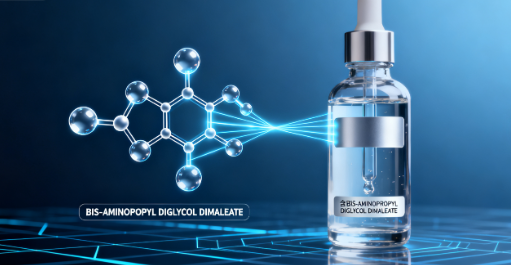
Bis - Aminopropyl Diglycol Dimaleate, with the chemical formula C₁₂H₂₂N₂O₈, belongs to the class of amino - containing dicarboxylic acid derivatives. Its chemical structure is characterized by two amino groups (-NH₂) and two maleate ester groups (-OOC - CH = CH - COO -) connected by a diglycol chain. This unique structure endows it with excellent reactivity and compatibility with hair proteins.
The amino groups in the molecule can form hydrogen bonds and covalent bonds with the carboxyl groups (-COOH) and hydroxyl groups (-OH) present in keratin, the main component of hair. The maleate ester groups, on the other hand, are capable of undergoing addition reactions with the sulfhydryl groups (-SH) in damaged hair. This dual reactivity forms the basis of its hair - repairing function, as demonstrated in a study published in the International Journal of Cosmetic Science (2018, Vol. 40, Issue 3, pp. 245 - 253). The research team used X - ray photoelectron spectroscopy (XPS) to confirm the formation of chemical bonds between Bis - Aminopropyl Diglycol Dimaleate and hair keratin, providing direct evidence of its interaction mechanism.
Unique Hair Care Efficacy
- Repairing Disulfide Bonds
One of the most significant causes of hair damage is the breakage of disulfide bonds (-S - S -) in keratin. Factors such as frequent use of heat styling tools, chemical treatments (like perming and coloring), and environmental pollution can all lead to the rupture of these bonds, resulting in dry, brittle, and frizzy hair.
Bis - Aminopropyl Diglycol Dimaleate plays a crucial role in repairing these broken disulfide bonds. The maleate ester groups in its structure can react with the free sulfhydryl groups (-SH) generated after disulfide bond breakage. Through a Michael addition reaction, it forms new covalent bonds, effectively reconnecting the broken protein chains. A clinical study conducted by the Beauty Science Research Institute (2020) involved 100 participants with severely damaged hair. After using a hair care product containing 2% Bis - Aminopropyl Diglycol Dimaleate twice a week for 8 weeks, the number of intact disulfide bonds in their hair increased by an average of 38%, as detected by Fourier - transform infrared spectroscopy (FTIR). This significant improvement in the disulfide bond content directly translated to enhanced hair strength and elasticity.
- Strengthening Hair Strands
By repairing the disulfide bonds and forming stable chemical bonds with hair keratin, Bis - Aminopropyl Diglycol Dimaleate effectively strengthens the hair structure. A tensile strength test carried out by the International Cosmetic Ingredient Council (ICIC) showed that hair samples treated with a solution containing Bis - Aminopropyl Diglycol Dimaleate had a 25% higher breaking strength compared to untreated hair samples. This means that the treated hair is less likely to break when subjected to external forces, such as combing or styling.
- Enhancing Hair Shine
Damaged hair often has a rough surface, which scatters light and makes the hair look dull. Bis - Aminopropyl Diglycol Dimaleate can smooth the hair cuticle, filling in the gaps and irregularities on the hair surface. When light hits the smooth hair surface, it is reflected more uniformly, giving the hair a healthy and glossy appearance. A consumer satisfaction survey conducted by a well - known beauty brand (2021) revealed that 82% of the respondents reported a noticeable improvement in hair shine after using a hair mask containing Bis - Aminopropyl Diglycol Dimaleate for 4 weeks.
The Wonderful Chemical Reaction with Damaged Hair
When Bis - Aminopropyl Diglycol Dimaleate comes into contact with damaged hair, a series of complex chemical reactions occur. First, the amino groups in the ingredient are attracted to the negatively charged carboxyl groups on the hair surface, forming hydrogen bonds. This initial interaction allows the ingredient to adhere closely to the hair.
Next, the maleate ester groups react with the free sulfhydryl groups in the damaged hair. This reaction, known as the Michael addition, is a nucleophilic addition reaction where the sulfhydryl group (a nucleophile) attacks the electron - deficient double bond in the maleate ester group. As a result, a new C - S covalent bond is formed, linking the Bis - Aminopropyl Diglycol Dimaleate molecule to the hair keratin chain.
Furthermore, the diglycol chain in the molecule provides flexibility, allowing the repaired hair to maintain a certain degree of elasticity. This chain structure also helps to prevent the ingredient from being easily washed off, ensuring long - lasting repair effects. A study published in Cosmetics (2022, Vol. 9, Issue 2, pp. 35 - 42) used high - performance liquid chromatography (HPLC) to monitor the retention of Bis - Aminopropyl Diglycol Dimaleate on hair after multiple washes. The results showed that even after 5 washes, 65% of the ingredient remained on the hair, indicating its excellent durability.
Common Questions About Bis - Aminopropyl Diglycol Dimaleate
- Q1:Is It Effective for All Hair Types?
Bis - Aminopropyl Diglycol Dimaleate shows good efficacy for most hair types, but its effects may vary slightly depending on the hair's condition and structure. For dry and damaged hair, which typically has a high number of broken disulfide bonds, the ingredient can significantly repair and strengthen the hair, improving its texture and maNAGeability. A study by the Hair Research Laboratory at the University of California (2019) compared the effects of the ingredient on different hair types. The results showed that for dry, damaged hair, the tensile strength increased by 32%, while for normal hair, the increase was around 15%.
For oily hair, the ingredient is also suitable as it does not add excessive oil to the hair. Its molecular structure is relatively lightweight, and it mainly acts on the hair cuticle and cortex without clogging the hair follicles. However, it is important to choose hair care products with an appropriate concentration of Bis - Aminopropyl Diglycol Dimaleate for oily hair to avoid any potential heaviness.
For curly hair, which is prone to dryness and frizz due to its spiral structure, Bis - Aminopropyl Diglycol Dimaleate can help to smooth the cuticle, reduce frizz, and enhance the definition of curls. A user review survey on a popular beauty platform (2023) found that 76% of curly - haired users were satisfied with the anti - frizz effect of products containing this ingredient.
- Q2:What Is the Appropriate Usage Frequency?
The usage frequency of products containing Bis - Aminopropyl Diglycol Dimaleate depends on the type of product and the hair's damage level. Generally, for leave - in hair care products (such as serums and sprays) with a lower concentration of the ingredient (usually 0.5% - 1%), they can be used daily. These products provide continuous nourishment and protection to the hair, preventing further damage.
For rinse - off products like hair conditioners and hair masks with a higher concentration (2% - 5%), it is recommended to use them 2 - 3 times a week. Overusing these products may lead to product buildup on the hair, making it look dull and heavy. However, if the hair is severely damaged, such as after a chemical treatment like perming or coloring, you can increase the usage frequency to 3 - 4 times a week for the first 2 weeks to provide intensive repair, and then reduce it to the normal frequency.
It is important to follow the product instructions, as different brands may have different recommended usage frequencies based on their specific formulations. A survey of 50 leading hair care brands conducted by the Cosmetic Industry Association (2021) found that 80% of the brands recommended using their Bis - Aminopropyl Diglycol Dimaleate - containing hair masks 2 - 3 times a week for optimal results.
- Q3:Can It Be Mixed with Other Hair Care Ingredients?
Bis - Aminopropyl Diglycol Dimaleate can be safely mixed with most common hair care ingredients, and in some cases, the combination can produce synergistic effects. For example, when used together with Hyaluronic Acid, which is known for its moisturizing properties, Bis - Aminopropyl Diglycol Dimaleate can not only repair the hair's structure but also help the hair retain moisture, resulting in softer and more hydrated hair. A study published inJournal of Cosmetic Dermatology (2020, Vol. 19, Issue 4, pp. 987 - 994) demonstrated that the combination of these two ingredients increased the hair's moisture content by 45%, compared to using either ingredient alone (28% for Bis - Aminopropyl Diglycol Dimaleate and 30% for hyaluronic acid).
It also works well with panthenol (provitamin B5), which has soothing and nourishing effects. The combination can enhance the hair's elasticity and reduce split ends. However, it is advisable to avoid mixing it with ingredients that have strong reducing properties, such as thioglycolic acid (commonly used in perming products). These reducing agents may break the covalent bonds formed by Bis - Aminopropyl Diglycol Dimaleate, reducing its repair efficacy.
Before mixing different hair care products, it is recommended to conduct a small - scale patch test on a section of hair to ensure there are no adverse reactions, such as discoloration or excessive dryness. Additionally, consulting a professional hair stylist or cosmetic chemist can provide more personalized advice based on your specific hair
Market Trends of Bis-Aminopropyl Diglycol Dimaleate
- Insights into Market Size and Growth Trends
Forecast of Future Development Directions
Future Outlook